
Stop. Reset. Build Better.
What “squaring the bench” does for your work and your thinking

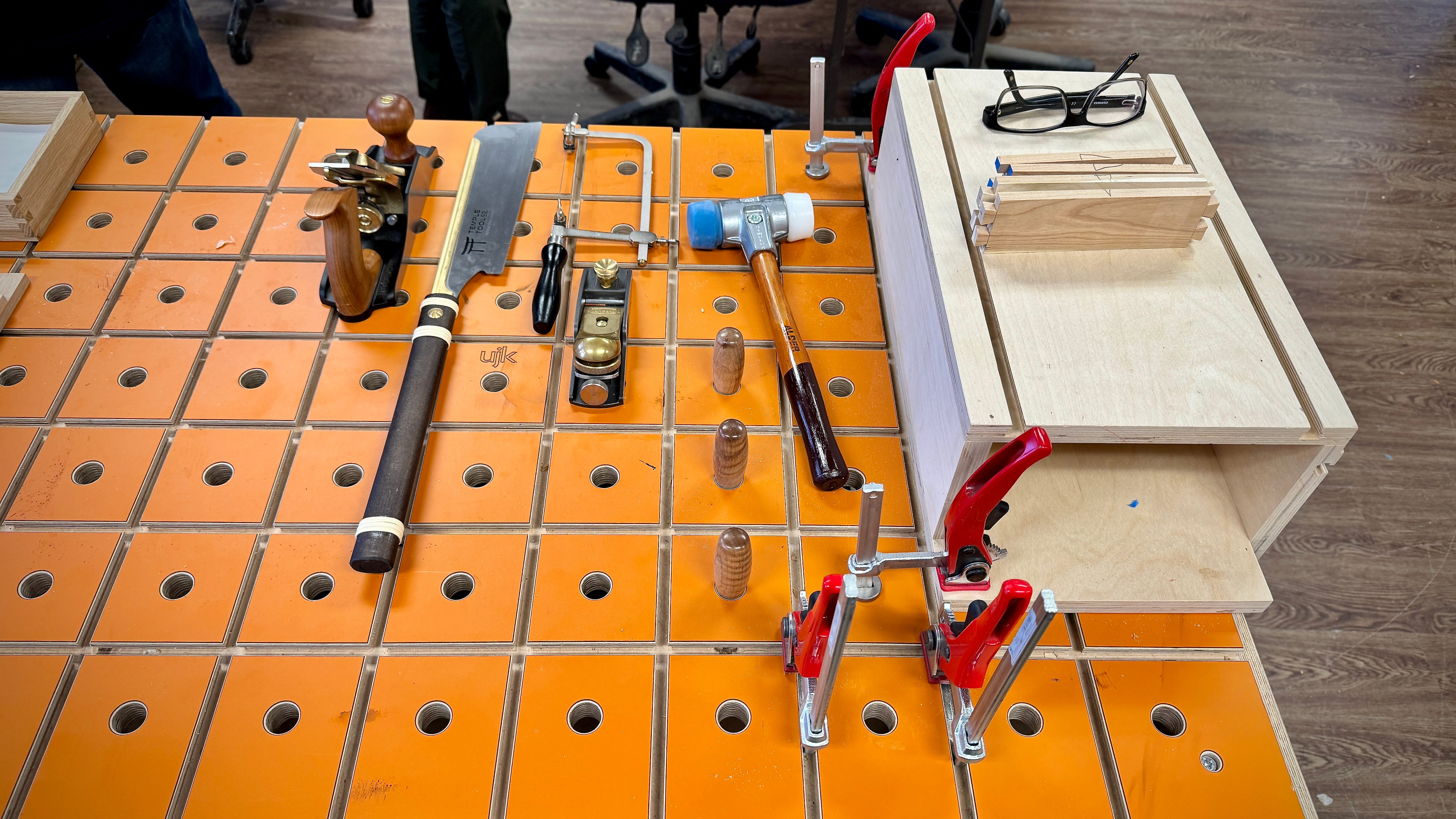
I was taught early on to tidy my bench throughout the day, not just at the end or when things started to get out of hand, but as a regular part of the process. The benches we used were on the smaller side, usually under two metres long and about 500 mm deep, which meant there wasn’t much room for tools, parts, and a glue-up all competing for space at the same time. If you didn’t stay on top of it, things would get crowded quickly, and you would end up spending more time moving things around than actually working.
It wasn’t something that was limited to woodworking. During my time in the military, we were expected to keep our work areas neat and organized at all times. I was in the artillery, and you don’t leave 45 kg projectiles lying around for someone to trip over, because at that point it’s not just untidy, it’s dangerous. The entire howitzer platform had a strict layout, where everything had a place and every position was set up the same way so that anyone could step in and know exactly where things were. I saw the same approach growing up with my dad, who was a painter. He cleaned as he worked so that he, or anyone else, wouldn’t step in paint trays or track paint through a finished space. At the end of each day, he would spend the last half hour resetting everything by cleaning his tools, vacuuming, and getting ready for the next day. Different environments, but the same underlying idea that order makes the work easier.
Some people say they thrive in chaos, but I’ve never found that to be the case for me. When my bench starts to get messy, I notice it right away. Things begin to slow down, I feel more scattered, and I start second guessing steps that would otherwise be straightforward. The work becomes harder than it needs to be, so I make a point of stopping to square the bench. That’s what I call it, and it takes a minute. Maybe two. During that time, I’ll put tools back where they live if I’m done with them, and the ones I’m still using get lined up so they’re easy to see and reach. I clear away any sawdust or shavings so I’m working on a clean surface again, and I’ll usually take a quick sip of coffee or water before getting back to it.
It’s a small pause, but it does something useful. It gives me a bit of space to think through what comes next, rather than just reacting and moving straight into the next step. I’ll run through the order of operations, consider what needs to happen next, and think about where mistakes are most likely to show up. That short reset helps me move forward with a bit more clarity instead of rushing ahead without thinking it through.
I’m also fairly deliberate about when I take those pauses. I tend to work from a checklist for whatever I’m building, and before I even start the day, I have a general sense of where I’m going to stop and reset. It might be after milling, before a glue-up, or when I’m about to switch machines. Without that, it’s easy for me to keep my head down and push through until the mess forces me to stop, and by then I’ve usually lost the thread of what I was doing. Taking a minute earlier on keeps me ahead of that.
I’m not going to tell you that you should work this way, because everyone approaches their work a little differently, and I’ve never been a fan of telling people how they ought to do things. Some people are comfortable juggling a number of tasks at once without it affecting their focus. I’m not wired that way. What I can say is that the work tends to feel easier when your space is under control. You make fewer mistakes, you move with a bit more confidence, and you spend less time working around clutter or looking for things you just had in your hand.
If your bench feels like it’s starting to work against you, it might be worth trying to square it up once or twice during a build and seeing what that does for you. It doesn’t have to be complicated. Just clear the surface, line things up, and give yourself a moment to reset before moving on.
In order to understand, you must do. - Vic
It’s often the little things, like squaring your bench, that make you a better woodworker. If you want help dialing in the details that actually move the needle, take a look at one-on-one mentorship. We can focus on your workflow, your setup, and the habits that are either helping or holding you back. Sometimes it only takes a few small shifts to make the work feel a whole lot easier.
Thanks Vic. I agree with all you said and it is my routine as well. At the end of the day I sharpen any chisels or planes that were put to task and are needed to be ready for tomorrow, and the work bench has to be cleaned off and tidy. It is a good way to start my next day with any project.
Cheers
Michael
Couldn't agree more. So many times I've WANTED to power through, but taken a break and end up coming back with a much better plan. Usually then executed better, and more safely, too. I was impressed with how I saw this approach to breaks codified when I was studying in Japan. Team tea breaks were frequent, and enforced. It wasn't just about having a sip of tea together; the ritual forces mental breaks across a team of carpenters that are all at different stages, and helps reduce the incidence of accidents.