
You’re Probably Overthinking Sharpening
Some have turned routine maintenance into philosophy, despite very little evidence that the tiny details matter much.

Sharpening might be the most overthought part of woodworking. Not joinery. Not design. Not finishing. Sharpening.
Woodworkers love to turn it into philosophy. Wear bevels. Secondary bevels. Hollow grinds. Flat grinds. Ruler tricks. Buffing compounds. Diamond stones versus water stones versus oil stones versus whatever new sharpening system showed up online this week promising enlightenment and a mirror polish. Somewhere along the way, sharpening stopped being routine maintenance and became something people endlessly speculate about.
I’ve spent a good chunk of my life around woodworking, and I’ve sharpened on just about everything: oil stones, water stones, diamond plates, sandpaper stuck to glass, powered systems, grinders, honing guides, and freehand. I’ve tried nearly every method because, like most woodworkers, I’m curious and occasionally gullible. Here’s what I’ve learned after all of it: almost every sharpening method works if you understand the process and stick with it. Seriously. Most systems can produce a wickedly sharp edge. What fascinates me is how much energy woodworkers spend arguing over tiny theoretical differences that often don’t seem to matter much once steel actually meets wood.
Take hollow grinding versus flat grinding. This debate comes up constantly, and both sides make reasonable arguments. One camp says hollow grinding is superior because the concavity creates two registration points, making honing easier and more repeatable. The other argues that flat grinding leaves more steel behind the edge, theoretically creating a stronger cutting edge. In theory, both positions make sense. In practice, though, I think we may be arguing over details that are simply too small to matter.
Let’s look at some numbers.
Modern bevel-up plane irons are all in roughly the same thickness range. An MTC blade comes in around 3.4 mm (0.134”), a Lie-Nielsen blade sits around 4.45 mm (0.175”), and Veritas lands around 4.76 mm (0.187”). If you calculate the actual depth of concavity created when grinding these blades on common grinder wheels, the numbers get surprisingly small.
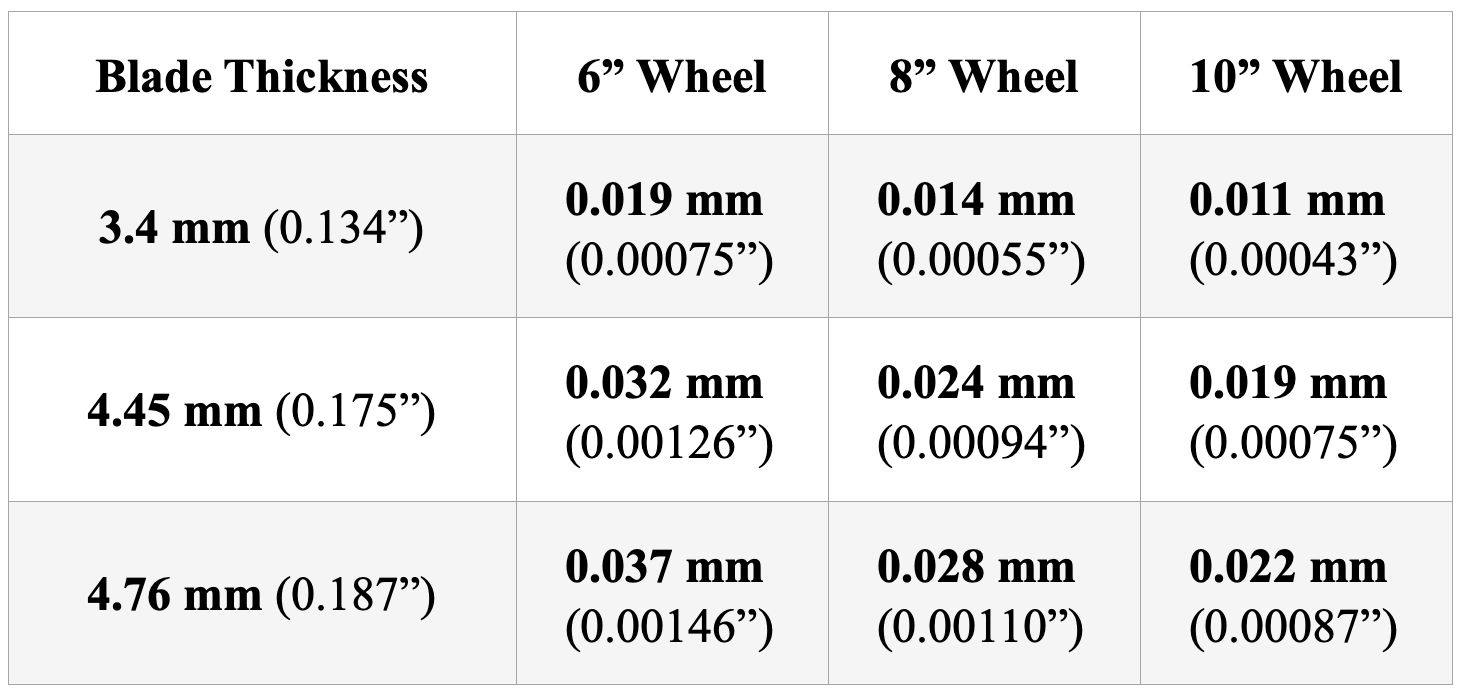
Take a second and actually look at those measurements. Even the deepest hollow, a thick Veritas blade ground on a small 6” wheel, produces only about 0.037 mm (0.00146”) of concavity. For perspective, that is thinner than most human hairs and only about one-third the thickness of a sheet of printer paper. Yet woodworkers will happily spend three hours online debating whether this microscopic difference is fundamentally changing the performance of a plane iron. Meanwhile, the wood doesn’t know the difference, or care for that matter.
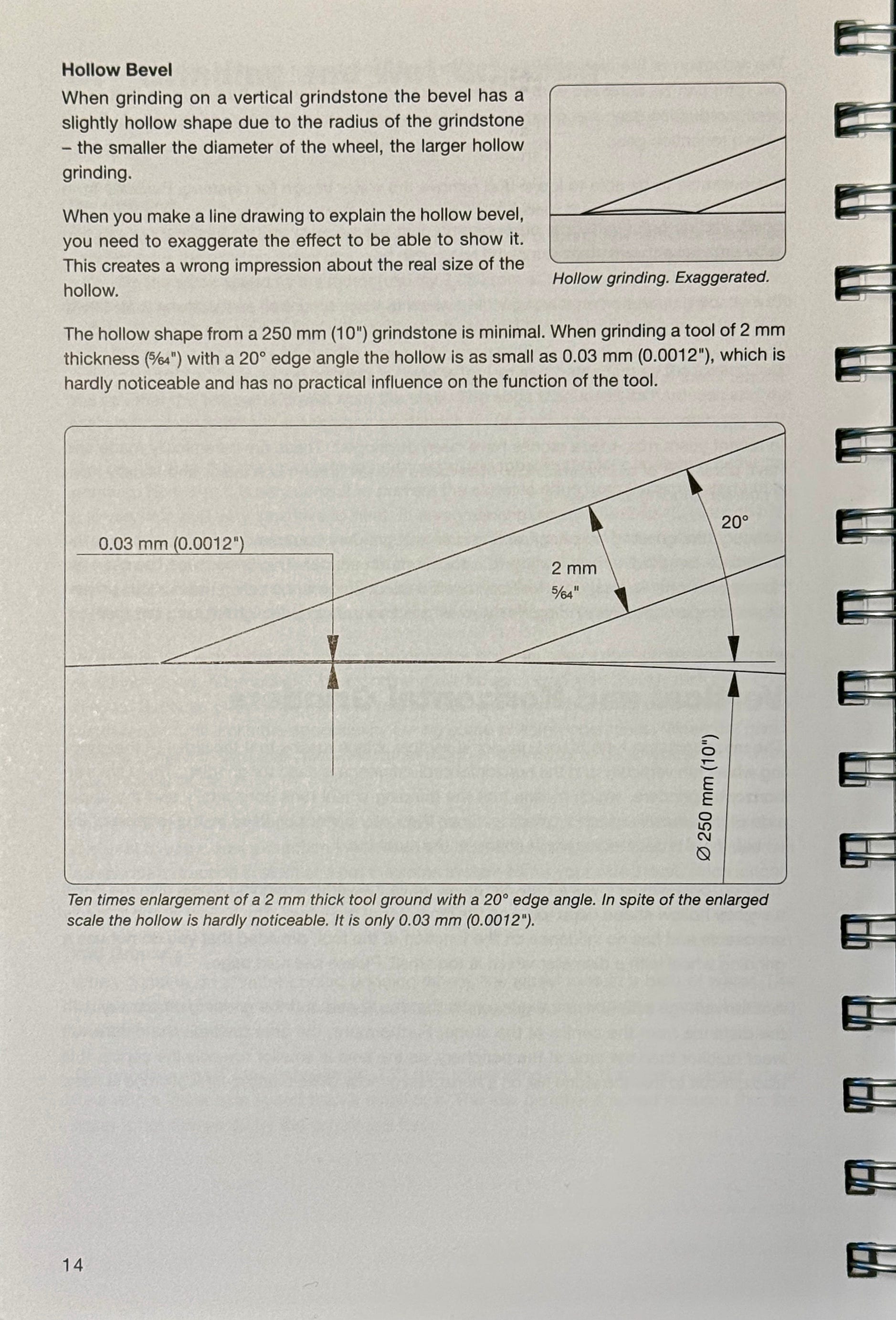
Now, before someone rushes to the comments, yes, theoretically there is a difference between hollow-ground and flat-ground geometry. Geometry is geometry. But here’s where things start to get muddy in practical woodworking. Most of us are not working with untouched hollow grinds because we sharpen, and most woodworkers are introducing some sort of microbevel, intentionally or not. After a few honing sessions, the geometry right at the cutting edge changes anyway. At that point, we are not really comparing a hollow-ground blade to a flat-ground blade anymore. We are comparing a hollow-ground blade with a microbevel to a flat-ground blade with a microbevel, and the practical differences become awfully difficult to isolate.
Could there be measurable differences in cutting force, edge retention, durability, or surface quality? Maybe. But here’s the interesting part: there are no peer-reviewed scientific studies comparing hollow-ground and flat-ground woodworking plane irons, at least none that I’m aware of. Which means much of the certainty around this topic comes from theory, habit, personal preference, and the woodworking equivalent of campfire stories.
That isn’t to say experience doesn’t matter. It absolutely does. Experience at the bench tells us quite a lot, and what my experience tells me is simple: sharp tools work, dull tools don’t. My friend Konrad Sauer of Sauer & Steiner Toolworks preps blades for his planes using a slow-speed 6” grinder equipped with a 46-grit wheel, then hones and polishes without a microbevel and with flat backs. No ruler tricks. His planes work beautifully. Meanwhile, countless other woodworkers swear by flat grinding and microbevels and also gets excellent results. This is often where sharpening discussions go sideways. People start treating different approaches as proof that one side must be right, when the reality is that several methods can lead to the same outcome.
And that outcome is simple. Wood does not care about your sharpening philosophy. Wood cares whether the edge is sharp.
That obsession with theory often distracts from something that matters far more in day-to-day woodworking: sharpening often enough. A lot of woodworkers wait too long. You can usually polish an edge a few times between full sharpening sessions, and a quick touch-up before the edge gets truly tired often takes just 30 seconds or so. But the longer you let an edge go, the longer it takes to bring back, which is where sharpening starts feeling miserable.
If your plane suddenly stops cutting the way it normally does, that’s the plane telling you the edge is dulling. Most people simply increase the depth of cut and carry on, but now you’re taking a slightly deeper cut with a duller blade, which sounds like a recipe for tear-out to me. Beginners especially get trapped in this cycle. They work with a dull tool until the thing feels awful, then spend half an hour trying to resurrect it and conclude sharpening itself is miserable.
It isn’t.
Neglect is miserable.
Go sharpen. Five minutes now usually saves thirty later.
And honestly, sharpening itself is much simpler than people make it sound. At its most basic level, you need to do two things:
Raise a burr on the back of the iron by working on the bevel up to your finest abrasive.
Remove the burr on the back with your finest abrasive.
That’s it. If you have done those two things successfully, you will have a sharp edge.
Some folks spend a lot of time talking about wear bevels, but I’m not convinced most woodworkers need to obsess over them. Just how much wear can a piece of wood, even a high-silica wood, really put on modern tool steel over a short working session? If you follow the two-step process above, you are removing whatever tiny wear bevel may have formed anyway. Raising the burr and then removing it takes care of the business end of the edge.
Everything else, bevel angles, wheel sizes, hollow versus flat, stropping compounds, boutique stones, is optimization. Useful optimization sometimes, absolutely, but still optimization.
If I had to guess where hollow grinding actually helps, I think the answer is consistency. A hollow grind gives you two easy registration points on the stone if you don’t want to use a honing guide, and for many people, especially beginners, that makes it easier to maintain an angle while honing. That matters, not because the geometry is magically superior, but because humans are inconsistent creatures.
That said, using a simple honing guide is a good way to acheive consistancy and I reccomend them all the time to my students.
If hollow grinding helps you sharpen more repeatably, great. Do it. If flat grinding works for you, also great. The best woodworkers I know aren’t spending their evenings arguing online about 0.037 mm. Their tools are sharp, their process is simple, and then they get back to building things.
Look, sharp tools are important. Nobody enjoys fighting a dull plane iron unless they also enjoy unnecessary suffering. Learn a sharpening system, stick to it, and stop searching for the mythical perfect edge. There comes a point where sharpening turns into procrastination disguised as craftsmanship, where people spend more time chasing microscopic geometry than actually making things. The wood has never cared how clever your sharpening theory was.
Most of the old furniture we admire wasn’t built by someone obsessing over wear bevels and arguing online about 0.01 mm. The tools were sharp enough, the work carried on, and furniture got built. That still feels like a pretty good model to me. The sharpest tool in the shop is useless if it spends more time on a stone than in wood.
In order to understand, you must do! - Vic
If sharpening still feels more frustrating than it should, or you’re tired of getting lost in conflicting advice online, mentorship can help cut through the noise. Sometimes all it takes is someone experienced looking at your setup, your process, and your technique to simplify things and get you moving forward with confidence. We can sort out sharpening, tool setup, or whatever else is slowing you down, so you can spend less time fighting your tools and more time building things. Check out my website to learn more about mentorship.
Welll, you have certainly given us much to think about. Sharpening is my least favorite thing to do, but it is equally the most important, and I do like a keen edge. I am a turner and an 18th century reenactor (although I consider myself to be more of a reendoer). That being said, my options for sharpening are quite limited. I use sandstone and slate slips and stropping. I have a 20 inch sandstone grinder but it is a lot of trouble to use. I mostly use slips and strops in a filing motion although on occasion l do drag an edge across a stone, mostly with plane irons.
As to sharpening for turning- 1. For dried and cured wood on electric lathes, 120 grit is the upper limit for grinding and honing because, friction. Friction causes heat which in turn buggers a very sharp edge as there is almost no metal there to dissipate the heat. Perhaps this is where I got my disdain for sharpening as I spent an awful lot of time trying to keep a good edge with small return for the time spent. 2. For turning green wood, as is necessary for using a pole lathe, good polished bevels and backs with well stropped faces is the limit. Scary sharp is, in any case, probably more a matter of one upmanship than practicality.
Actually, flat grinding does not necessarily leave more steel behind the edge. With a slight adjustment, you can make the angle at the edge the same with a hollow grind. And when you do, you now have more steel behind the hollow grind.